
Cell Phones and International Travel: What to Know
In today’s hyper-connected world, our smartphones have become far more than devices for making phone calls. We rely on them for navigation, translation, restaurant recommendations, travel reservations, and staying in touch with family and friends.
So when it comes time to travel internationally, many travelers find themselves asking an important question:
What are my options for using my cell phone when traveling internationally?
No matter where your next adventure takes you, having a plan for how you’ll use your phone can make your travels smoother, safer, and far more enjoyable.
In this guide, we’ll walk you through what to know about using your cell phone internationally, from budget-friendly options to full-service mobile plans. Whether you’re a frequent traveler or taking your first international trip, you’ll find the right approach for staying connected without overspending.
Do I Need to Pay for Cell Service While Traveling Internationally?
Short answer: No.
You don’t have to spend a dime on international cell service if you don’t want to.
Many travelers simply leave their phones in airplane mode and rely on Wi-Fi during their trip. In fact, in many destinations around the world, it’s easier than ever to find free Wi-Fi at airports, hotels, restaurants, and even public city centers.
That said, staying connected with active mobile service while traveling does offer several advantages:
- Access to maps and GPS without needing Wi-Fi
- On-the-go communication through messaging or voice calls
- Emergency contact access without delay
- Instant translation tools in unfamiliar languages
- Quick restaurant and attraction searches
The key is choosing the best mobile strategy based on your destination, trip length, budget, and communication needs.
Our Top 5 Cell Phone Options When Traveling Internationally
Here are five of the most popular and effective ways travelers stay connected abroad:
- Use your current calling plan and pay a daily fee
- Add an international monthly travel plan
- Stay in airplane mode and use Wi-Fi
- Use an eSIM
- Share one device among travel companions
Let’s look at each option in more detail.
Option 1: Use Your Current Cell Plan and Pay a Daily Fee
This is one of the simplest and most convenient ways to stay connected abroad.
Major U.S. carriers such as Verizon, AT&T, and T-Mobile offer international roaming plans that charge a flat daily rate when you use your phone overseas.
How It Works:
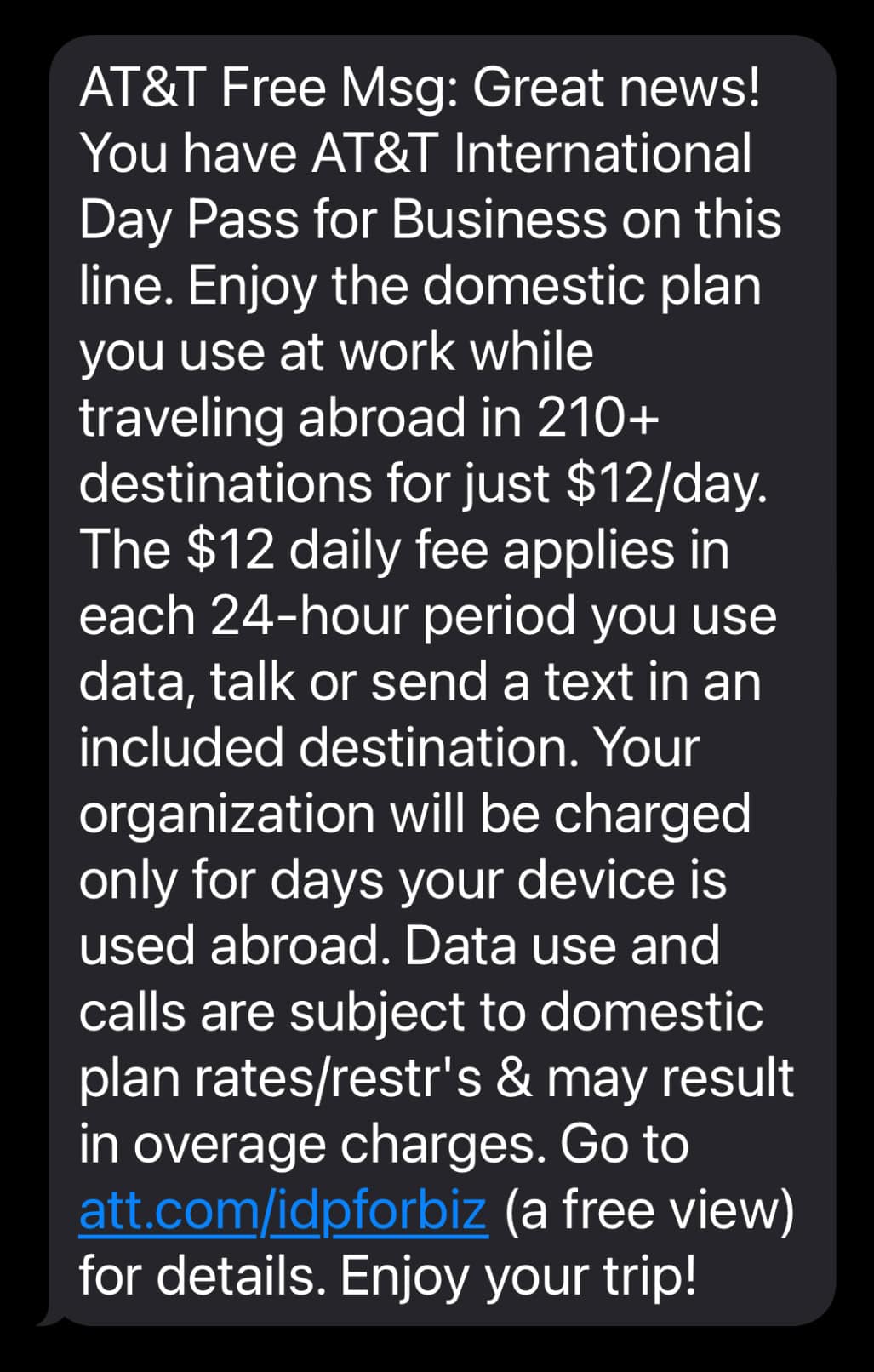
When you land in a foreign country and turn off airplane mode, you’ll typically receive a text message notifying you that international service has been activated.
Most daily international plans cost around $10–$12 per day, depending on your carrier.
Once activated, you can use your phone just like you do at home, calling, texting, browsing the internet, using maps, and accessing apps, with the additional daily charge added to your bill.
Pros:
- No setup required
- Immediate access to data and calls
- Works exactly like your normal phone plan
Cons:
- Costs can add up quickly
- You may be charged each day your phone connects to a foreign network, even if you only use it briefly
For example, if your phone briefly connects while passing through another country during a layover, that connection may still trigger the daily fee.
✈️ Example: When we landed in Dubai, Chandler received a text from AT&T letting him know that his plan was active for international use at $12 per day.
With no extra setup needed, he simply turned off airplane mode and started using his phone as usual. He checked maps, sent messages, and even streamed music during our ride from the airport.
The daily charges were automatically added to his next phone bill, making it a hassle-free but slightly more expensive option for staying connected.
Option 2: Add a Monthly International Calling Plan
If you’re traveling for an extended period of time, a monthly international plan may save you money.
Example:
During our month-long trip to New Zealand and Australia, I added Verizon’s International Monthly Plan, which cost $100 for 30 days of coverage.
That was a significant savings compared to the $270 I would have paid using the $10-per-day plan.
Benefits:
- Ideal for longer trips (two weeks or more)
- Predictable flat rate pricing
- Often includes more data than daily roaming plans
Before you travel, check with your carrier to see which international packages are available. Many providers allow you to schedule your travel dates in advance, so service activates automatically when you arrive.
Option 3: Stay in Airplane Mode and Use Wi-Fi Only
Using Wi-Fi while keeping your phone in airplane mode is the most cost-effective option for international travel.
It’s also a great choice if you want to disconnect a bit and enjoy your vacation without constant notifications.
How it works:
- Put your phone in airplane mode for the entire trip.
- Turn Wi-Fi back on so you can connect to networks.
- Download maps, entertainment, and apps before you leave.

Be sure to download:
- Offline Google Maps.
- Audiobooks or music.
- Boarding passes and reservations.
- Language translation packs.
If you have an iPhone and your friends or family do too, iMessage and FaceTime work seamlessly over Wi-Fi.
For communication between different phone types, apps like WhatsApp are excellent for free messaging and calls.
⚠️ Security Tip: Be Careful When Using Public Wi-Fi
Free Wi-Fi is convenient, but it isn’t always secure.
Public networks in airports, hotels, cafés, and train stations are often unsecured, which means hackers may be able to intercept information transmitted over the network.
When using public Wi-Fi during international travel, follow a few simple safety precautions.
Best Practices for Using Public Wi-Fi Safely
Avoid logging into sensitive accounts such as:
- Banking apps
- Financial websites
Additional safety tips include:
- Turn off automatic Wi-Fi connections
- Confirm the correct network name with staff
- Disable file sharing or AirDrop
- Log out of accounts after use
If you plan to rely heavily on public Wi-Fi, consider using a VPN (Virtual Private Network).
A VPN encrypts your internet traffic, making it far more difficult for someone on the same network to intercept your data.
Where to Find Free Wi-Fi:
Free Wi-Fi is widely available in many destinations around the world.
Common places include:
Hotels
Most major hotel chains, including Hilton, Marriott, and Hyatt, offer Wi-Fi for guests.
Airports
Nearly all international airports now provide free Wi-Fi access.
Restaurants and Cafés
Chains like Starbucks and McDonald’s often provide free Wi-Fi, along with many local cafés.
Public Spaces
City centers, libraries, and trains sometimes offer free connections as well.
Option 4: Use an eSIM
If you want local service at local prices, using an eSIM is one of the smartest travel options available today.
What’s the difference between an eSIM and a physical SIM?
Physical SIM
A small chip inserted into your phone that connects to a cellular network.
eSIM
A digital SIM that can be installed directly through your phone’s settings without removing your existing SIM card.
Where to Buy eSIMs
You can purchase eSIM plans from:
- Local carrier stores
- Airport kiosks
- Online providers such as eSIM.sm
Pros
- Often much cheaper than U.S. roaming
- Provides local cellular service
- Works well for multi-country travel
Cons
- Your phone must support eSIM technology
- Setup may be unfamiliar for first-time users
📱 Mind Set On Travel Tip:
We’ve used eSIM.sm, and the setup process was surprisingly simple. The app walks you through each step, making it easy to activate service before your trip.
Click HERE to explore that option.
Option 5: Share One Phone Among Travel Companions
If you’re traveling with a partner or group, another simple strategy is to activate international service on just one phone.
For example, Chandler and I sometimes choose to activate roaming on only one device. We use that phone for:
- Navigation
- Reservations and bookings
- Emergency communication
The second phone remains in airplane mode and connects to Wi-Fi when needed.
Pros:
- Cut international costs in half
- Still provides access to navigation and communication
Just make sure family or friends know which phone number to contact while you’re traveling.
How to Prepare Your Phone Before Traveling Abroad
A little preparation can save you frustration once you arrive at your destination.
Before your trip:
Contact Your Carrier
Ask about:
- International roaming fees
- Travel plans
- Unlocking your phone if necessary
Download Offline Maps
Google Maps allows you to download entire cities or regions for offline navigation.
Install Travel Apps
Helpful apps include:
- Google Translate
- Uber
- Airline apps
Enable Security Features
Turn on features such as:
- Face ID
- Two-factor authentication
- “Find My iPhone” or Android Device Manager
Backing up your phone before your trip is also a smart idea in case your device is lost or stolen.
Final Thoughts: Staying Connected While Traveling Internationally
Whether you rely on Wi-Fi, activate a daily roaming plan, or use an eSIM card, there’s no single right answer.
The best choice depends on your travel style, budget, and how connected you want to be during your trip.
The important thing is to plan ahead and understand your options. Smartphones can be incredibly helpful travel tools, and with a little preparation you can avoid surprise charges, connectivity frustrations, and security risks.
So the next time you’re packing your bags for an international adventure, don’t forget to pack a plan for your phone.
You’ll be glad you did when you’re navigating a foreign city, translating a menu, or sharing travel memories with friends and family back home.
🌍✈️ Happy Traveling! May your adventures be smooth, your Wi-Fi strong, and your eSIM connections seamless!
💡 Additional Travel Resources
Staying connected while traveling internationally is just one part of a smooth adventure. Whether you’re planning your first trip abroad or your fiftieth, having the right mindset, resources, and inspiration can make all the difference. Here are some additional resources that you could find valuable:
Check out our Travel Resources page to see all the tools we use to plan our trips. From booking flights and hotels to tours and local experiences, we share what works to make travel simpler and smarter.
Explore our Destinations & Itineraries page for ideas on where to go next. See the places we’ve visited, the adventures we’ve taken, and get inspiration for your own travel bucket list.
Check out our Mindset Stories to learn how to manage your thinking and gain the confidence to travel anywhere. From handling travel anxiety to embracing new experiences, these stories help you celebrate every win along the way.
Join Mind Set On Travel on Pinterest and Facebook for more travel inspiration, mindset tools, and expert tips!
Affiliate Disclosure
Mind Set On Travel may contain affiliate links to products and services, including Amazon affiliate links. If you make a purchase using one of our links, we may receive compensation at no additional cost to you. This helps support our work and allows us to continue sharing travel tips, resources, and mindset stories.
As an Amazon Associate, we earn from qualifying purchases.
Thank you for supporting Mind Set On Travel!
Read our full disclaimer here.