Hawaii State Capitol: U.S. Capitols Challenge
As part of our 50 State Capitols Challenge, we’ve discovered that every state capitol has its own personality. Some impress with towering domes, grand marble staircases, and ornate rotundas. Others tell the story of their state through artwork, history, and architecture.
Then we arrived in Honolulu.
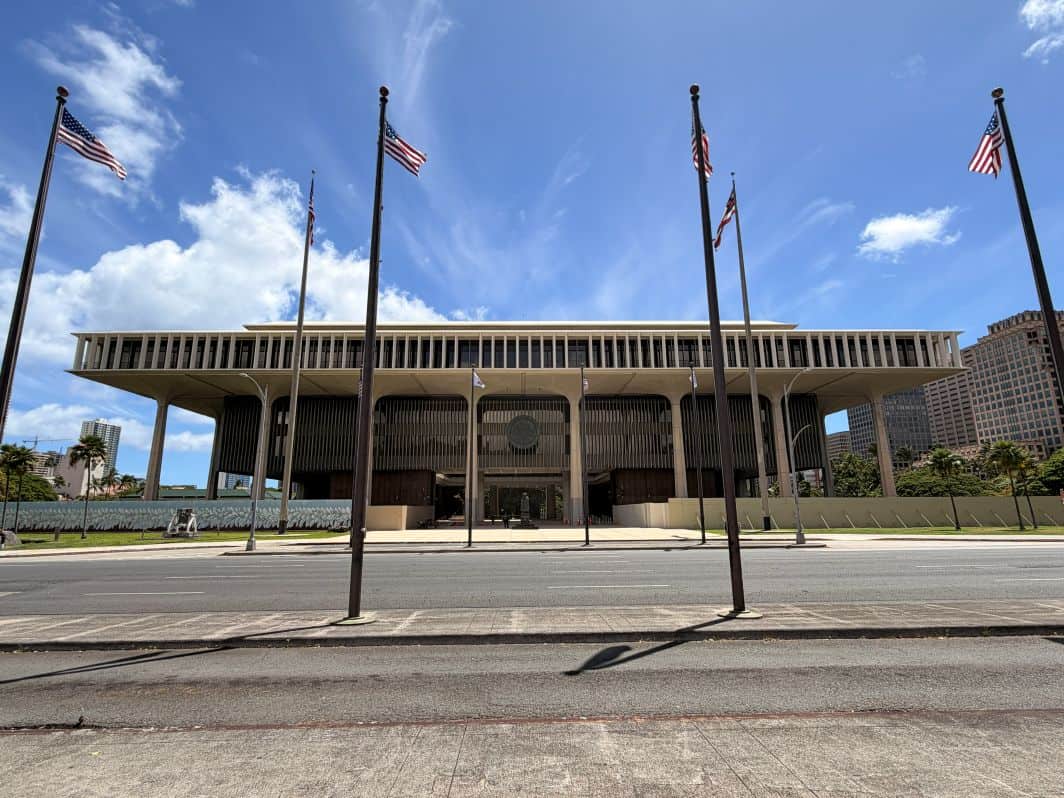
The Hawaii State Capitol isn’t just different from the other state capitols we’ve visited, it’s unlike any capitol in the United States. Instead of a massive enclosed dome rising above the building, the center is open to the Hawaiian sky. Rather than a traditional rotunda, you’ll find an open-air courtyard that welcomes sunlight, fresh air, and the tropical climate into the heart of the Capitol.
Join us as we explore the Hawaii State Capitol and discover why this is a unique stop on our journey to visit all 50 state capitols.
First Impressions of the Hawaii State Capitol
Walking toward the Hawaii State Capitol, the first thing we noticed was how different it felt compared to every other state capitol we had visited.
There was no towering dome dominating the skyline or grand staircase leading to an ornate entrance. Instead, the building’s clean lines and open design blended naturally with Hawaii’s tropical landscape.
Even before entering, it is clear this is a capitol designed to reflect its environment rather than overpower it.
Entrance Features of the Hawaii State Capitol
The Replica Liberty Bell
One of the first things we saw was the Replica Liberty Bell.
As part of our 50 State Capitols Challenge, we’ve made it a tradition to search for these replicas whenever we visit a state capitol.
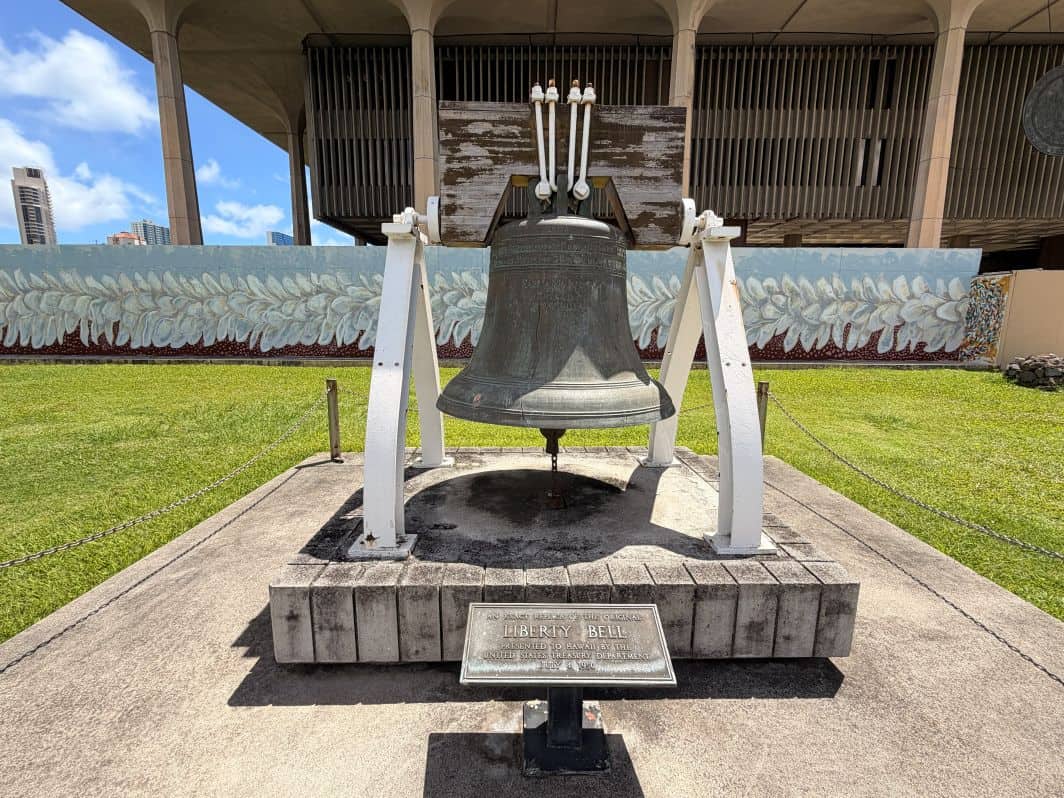
Easily visible as you approach the building, the bell serves as a reminder of the ideals of liberty and democracy that unite every state.
Finding each replica has become a fun tradition during our Capitol Challenge, and Hawaii’s was one of the easiest to spot.
Statue of Father Damien
Near the Capitol entrance stands a statue of Father Damien, one of Hawaii’s most beloved historical figures.
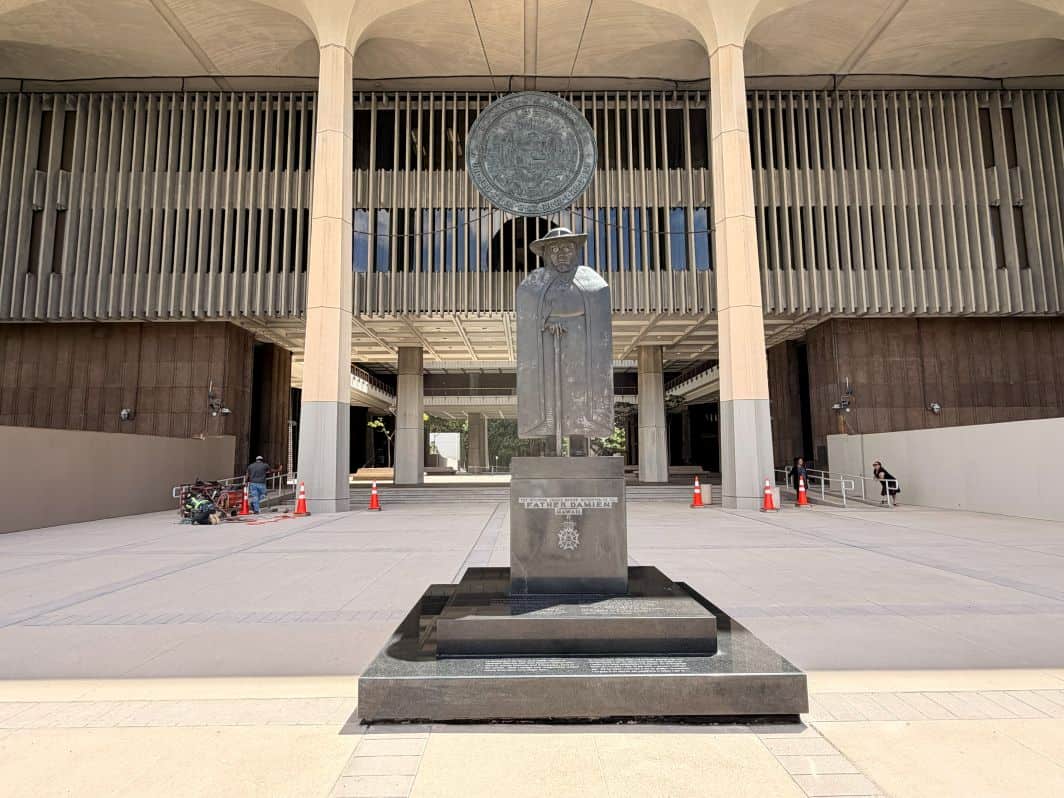
Father Damien devoted his life to serving people living with Hansen’s disease on the island of Molokaʻi.
His compassion, courage, and willingness to live alongside those he cared for left a lasting legacy.
The statue serves as a fitting tribute to a man whose life exemplified service, sacrifice, and kindness. Values that continue to resonate throughout Hawaii and beyond.
The Seal of the State of Hawaii
Looking above the entrance, you’ll notice the large Seal of the State of Hawaii prominently displayed.
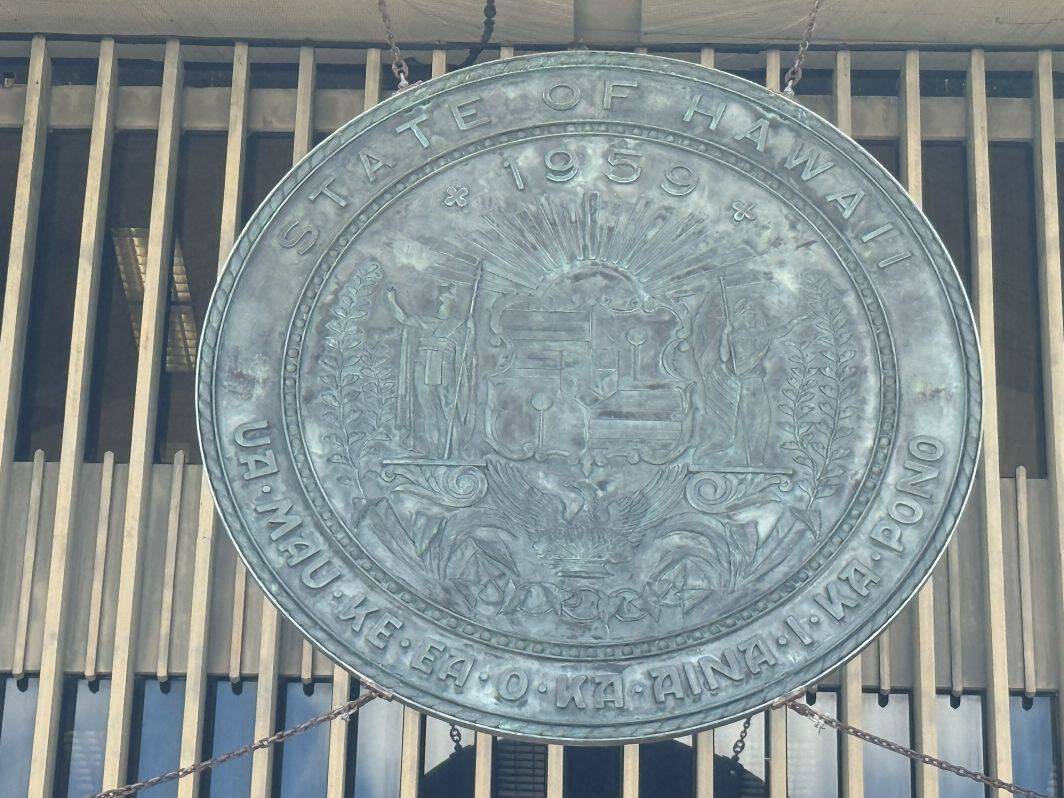
Rich in symbolism, the seal represents Hawaii’s unique heritage, blending elements of the former Hawaiian Kingdom with symbols of statehood.
It’s another reminder that the Hawaii State Capitol was thoughtfully designed to honor the state’s history while serving its future.
Positioned above the statue of Father Damien, the colorful seal immediately draws your attention and welcomes visitors to the home of Hawaii’s state government.
The Reflecting Pool Renovation
One item we learned after our visit was that the Hawaii State Capitol was previously surrounded by reflecting pools. These pools are designed to frame the building and enhance the sense of it floating within the landscape, echoing the Pacific Ocean that surrounds the Hawaiian Islands.
The renovations at the Capitol are estimated to be completed in the fall of 2027.
Entering the Open-Air Rotunda and Dome
As we continued into the Hawaii State Capitol, we stepped into what we would normally consider the building’s rotunda and dome. But neither label quite fits what you actually experience here.
The Open Dome
Instead of walking into a grand, enclosed circular chamber topped by a soaring dome, we found ourselves in an open-air central courtyard.
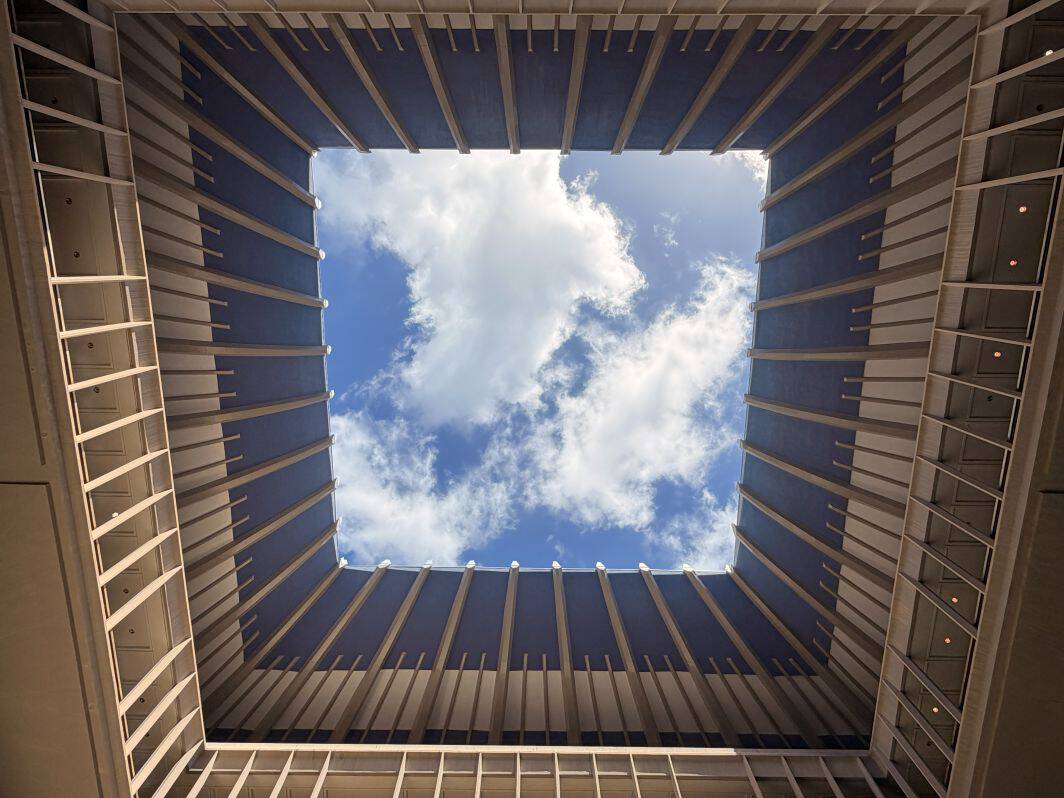
The sky replaces the ceiling. The air moves freely through the space. And rather than being enclosed by walls and ornamentation, the Capitol opens outward in every direction.
The Mosaic Aquarius
At the center of this space is a striking mosaic tile design that immediately draws your attention downward.
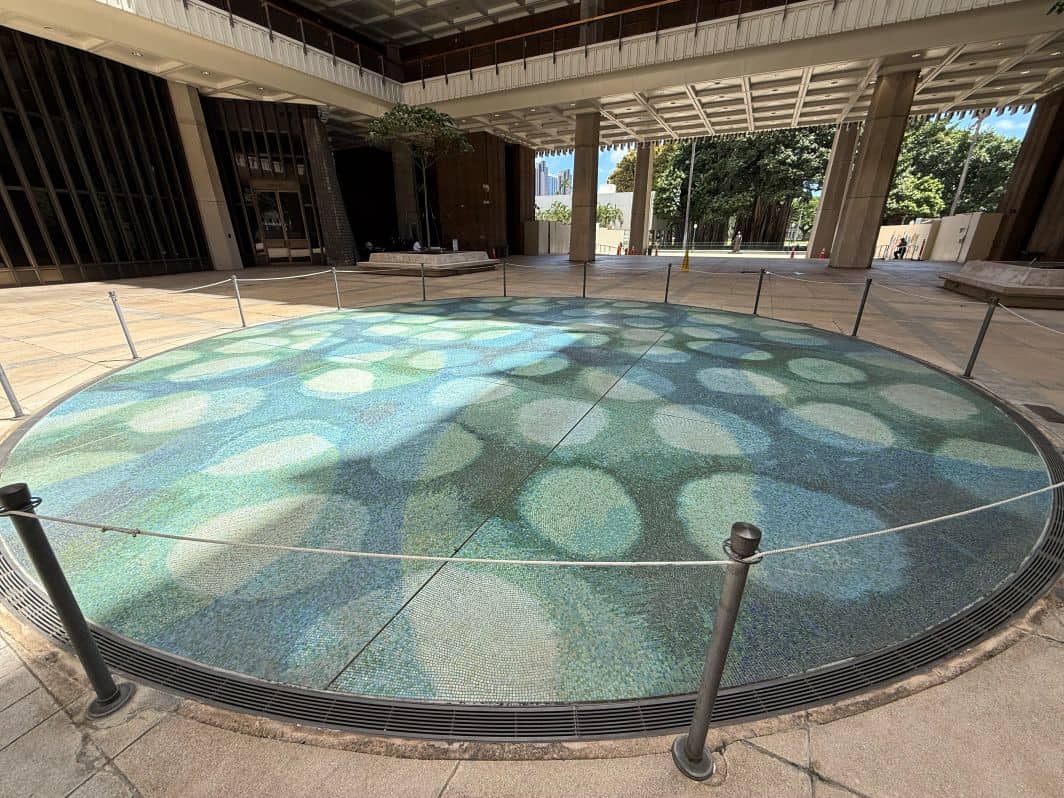
The artwork adds color, texture, and symbolism to an otherwise minimal architectural environment. It draws the eye downward while the open sky pulls it upward, creating a powerful sense of balance between land and air.
What makes this area so unique is that it challenges your expectations of what a state capitol should look like. There is no heavy dome overhead, no echoing rotunda filled with marble and statues. Instead, the architecture embraces Hawaii’s environment of sunlight, wind, and open sky and becomes part of the design itself.
Looking Into the Legislative Chambers
Because we were visiting on a self-guided tour, we weren’t able to enter the legislative chambers themselves. Instead, we viewed both the Senate and House of Representatives chambers through the exterior windows.
The Senate Chamber
One of the first things that stood out was the cool color palette inside the room; blues and greens that immediately created a calm, grounded atmosphere.
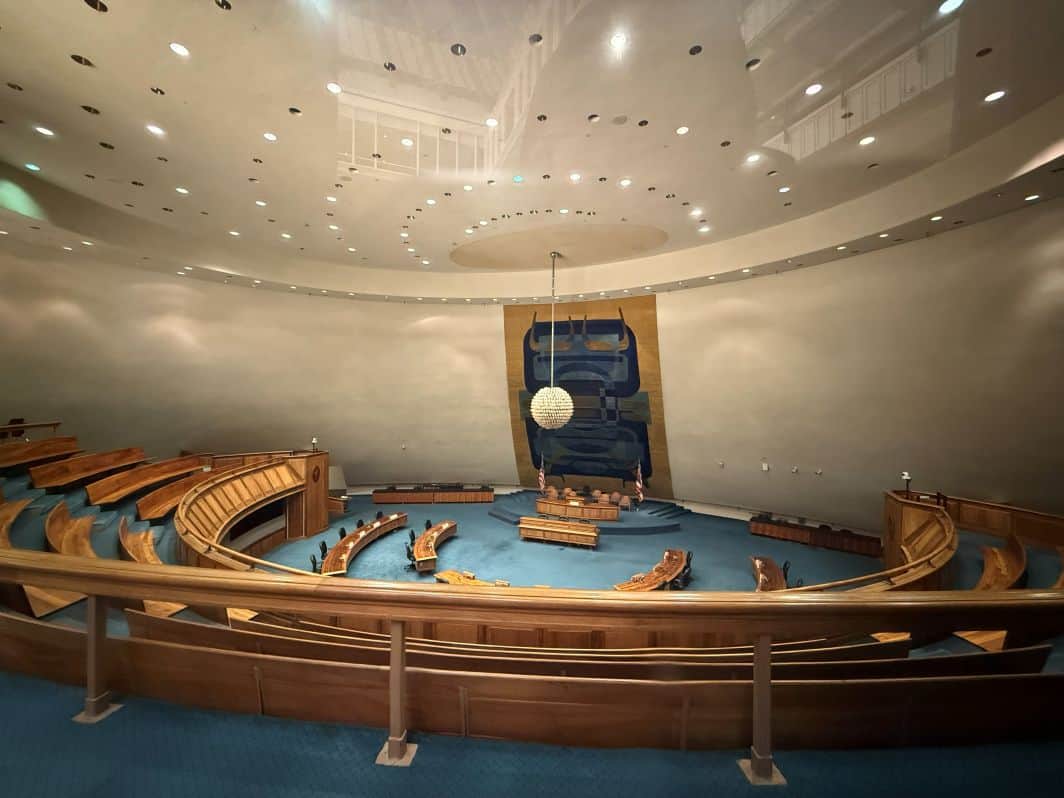
The blue and green tones gave the chamber a sense of openness and flow, almost echoing the surrounding ocean and natural landscape of the islands.
Even from this vantage point, the space felt modern and uncluttered, with clean lines and a design that emphasizes function over ornamentation.
The House of Representatives Chamber
Directly across from the Senate Chamber, we also viewed the House of Representatives Chamber through the exterior windows.
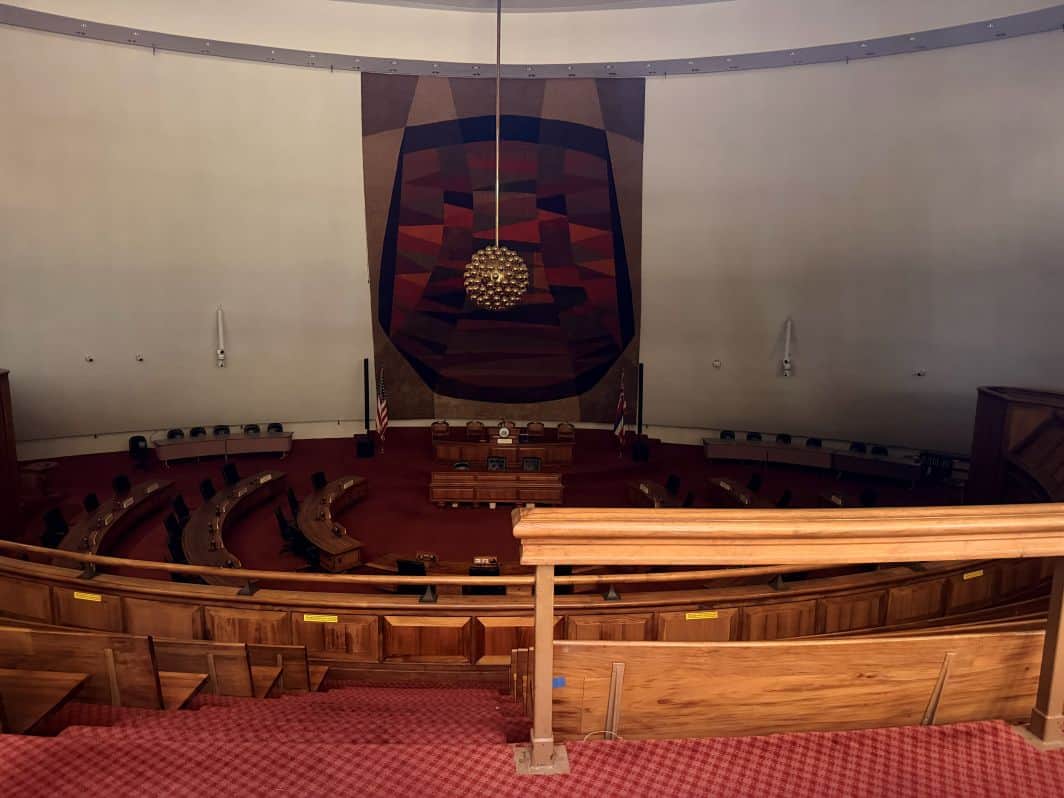
In contrast to the cooler tones of the Senate, this space featured warmer colors: reds, oranges, and tans.
The palette created a noticeably different energy, giving the chamber a more earthy feel that echoed the island environment surrounding us.
Like the Senate, the design was simple and modern, but the color choices helped distinguish the two legislative bodies in a subtle yet meaningful way.
Looking Down From the Upper Levels
We made our way up to the upper level of the Hawaii State Capitol to get a different perspective of the building. From above, we could look down into the open central spaces and better understand how the structure is connected from floor to floor.
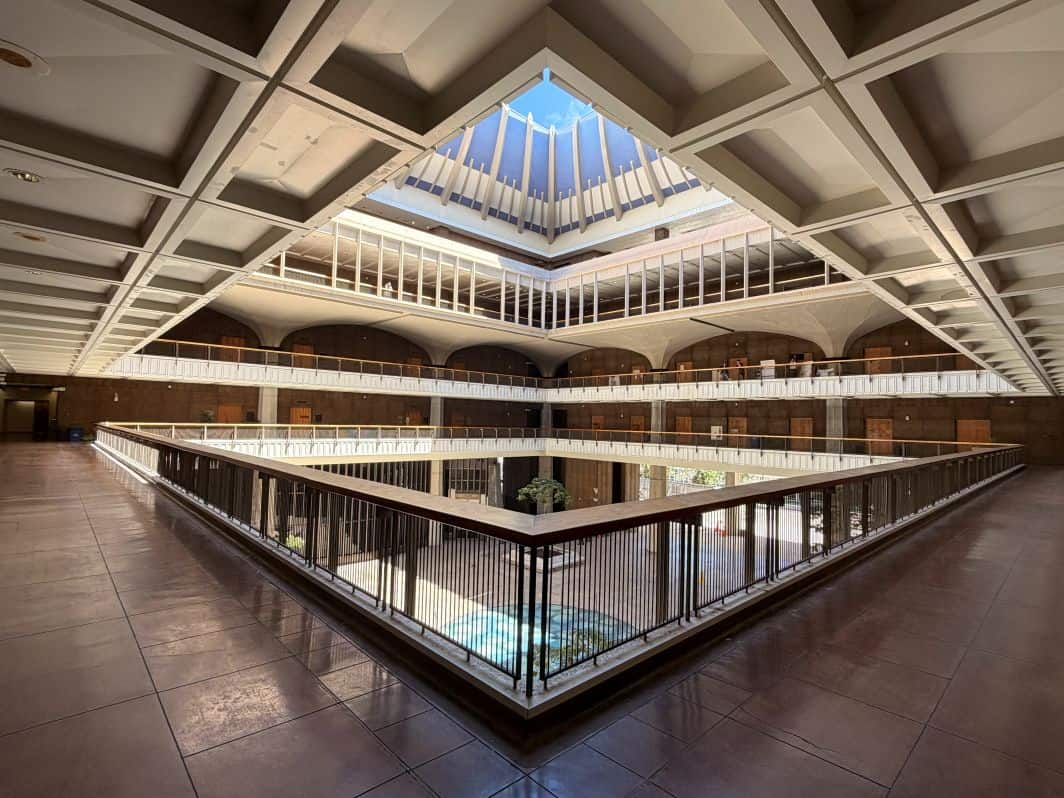
Looking into the open-air center, the absence of a traditional dome felt even more intentional. Natural light filled the space from above, and the entire building seemed designed to stay visually connected from every angle, top to bottom.
It was a unique perspective that helped us appreciate how thoughtfully the Capitol was designed, not just as a symbolic structure, but as a working government building that remains open and connected.
Queen Liliʻuokalani Statue and the Rear of the Capitol
As we made our way toward the back of the Hawaii State Capitol, the atmosphere shifted from modern government to something more historical. Here, we encountered the statue of Queen Liliʻuokalani, the last reigning monarch of the Hawaiian Kingdom.
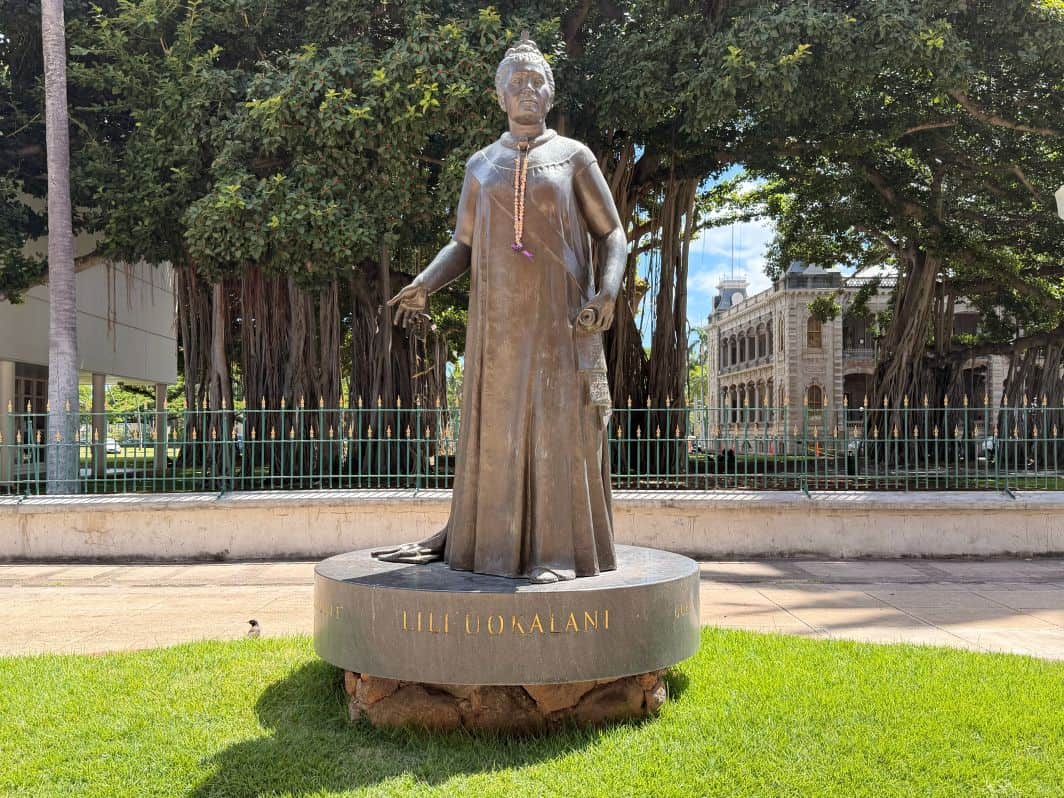
Standing with quiet dignity, the statue serves as a powerful reminder of Hawaii’s complex history and the transition from monarchy to U.S. statehood.
She represents the resilience and identity of the Hawaiian people.
ʻIolani Palace: The Royal Heart of Hawaii
Just behind the Hawaii State Capitol sits one of the most significant landmarks in the state: ʻIolani Palace. Seeing it so close to the seat of modern government creates a powerful contrast between Hawaii’s past and present.
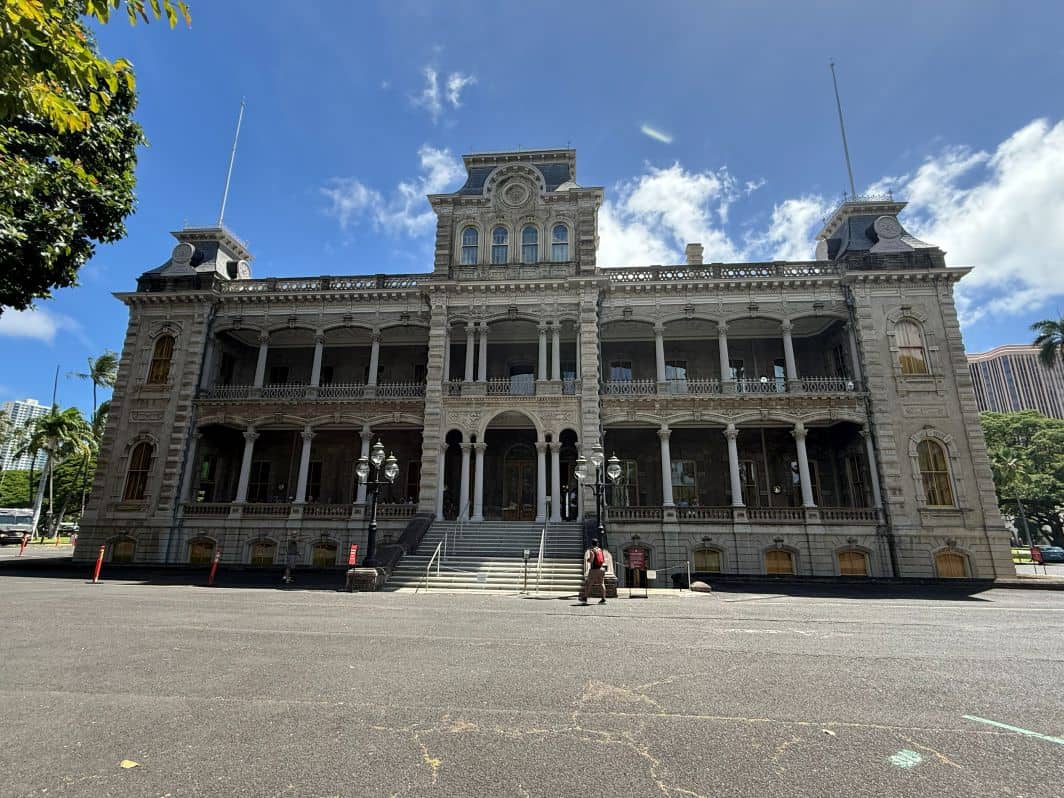
ʻIolani Palace is the only official royal palace on American soil and was once the residence of Hawaii’s monarchy.
It stands as a direct link to the era when the Hawaiian Kingdom was still an independent nation, long before statehood.
Helpful Tips for Visiting the Hawaii State Capitol
If you’re planning your own visit as part of a Hawaii itinerary or a broader state capitols challenge, the Hawaii State Capitol is easy to include in a day of exploring downtown Honolulu.
One of the most important things to know is that guided tours are available Tuesday through Friday at 1:00 p.m. These tours provide access to areas that aren’t open during a self-guided visit. If your schedule allows, this is the best way to experience the Capitol in full.
Since we were exploring other parts of Oʻahu, we visited on a self-guided basis. Even without the tour, it’s still easy to walk the exterior grounds and view many of the key features, including the open-air courtyard, surrounding monuments, and views into the legislative chambers through the windows.
Final Thoughts: Hawaii State Capitol
As we continue our 50 State Capitols Challenge, the Hawaii State Capitol stands out as one of the most unique Capitols we’ve experienced. While many capitols across the United States share similar architectural influences like grand domes, marble interiors, and traditional rotundas, Hawaii chose a completely different path.
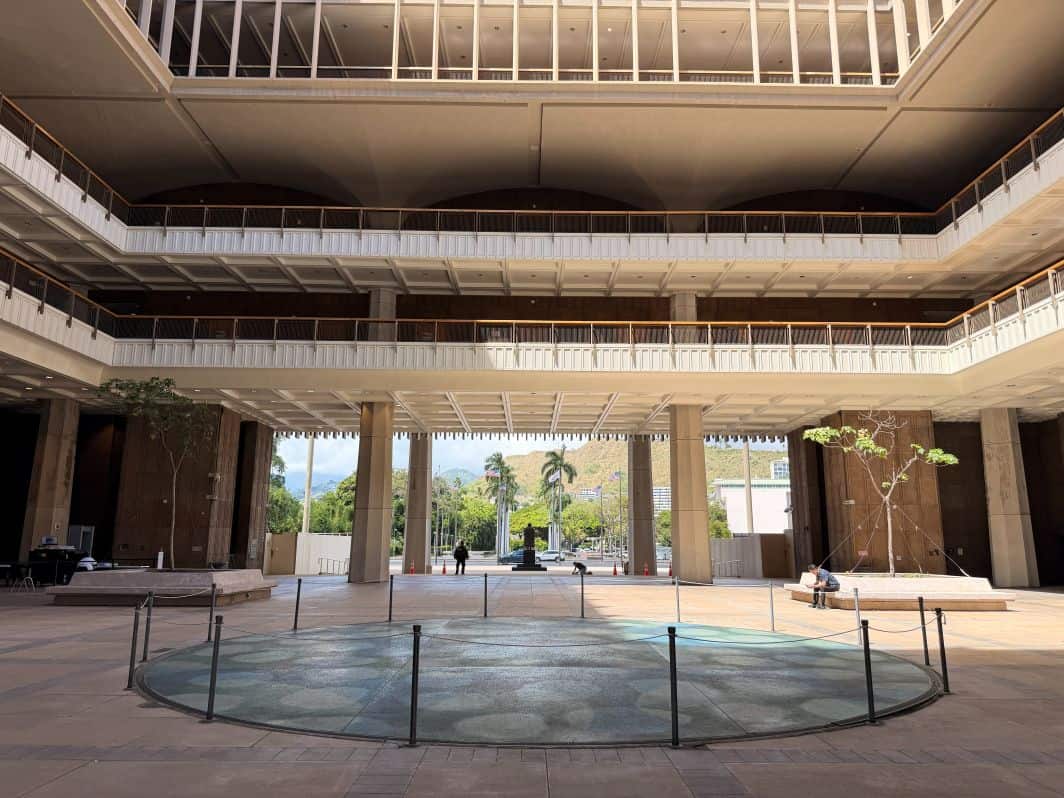
Here, the design is open, intentional, and deeply connected to the environment. The sky replaces the dome, the courtyard replaces the rotunda, and the surrounding landscape becomes part of the architecture itself.
Even the monuments, color choices, and surrounding landmarks all contribute to a Capitol that feels uniquely Hawaiian rather than traditionally governmental.
Even with limited access during a self-guided visit, the experience was memorable. Every element reflects Hawaii’s identity in a thoughtful and meaningful way.
This stop didn’t just add another capitol to our list. It reshaped how we think about what a state capitol can be.
Keep Exploring with Us!
If you enjoyed exploring the Hawaii State Capitol, continue the journey through our 50 State Capitols Challenge and discover the unique stories behind the other capitols we’ve visited across the United States. Each one offers its own blend of architecture, history, and local character that makes this challenge so meaningful.
If you’re inspired to start your own state capitol adventure, visit our Resources page to find the tools we use to plan, book, and organize our travels. From trip planning platforms to booking resources, it’s everything you need to begin your own Capitol Challenge or explore state capitols on your next trip.
Affiliate Disclosure
Mind Set On Travel may contain affiliate links to products and services, including Amazon affiliate links. If you make a purchase using one of our links, we may receive compensation at no additional cost to you. This helps support our work and allows us to continue sharing travel tips, resources, and mindset stories.
As an Amazon Associate, we earn from qualifying purchases.
Thank you for supporting Mind Set On Travel!
Read our full disclaimer here.