
South Carolina State House: U.S. Capitols Challenge
After visiting all 50 states, we asked ourselves one simple question: What adventure comes next?
That question led us to a new challenge: visiting every U.S. State Capitol. Now, we’re exploring these historic landmarks one Capitol at a time and sharing our stories to inspire your own journey.
Latest stop on our 50 State Capitols Challenge: the South Carolina State House in Columbia.
Every Capitol Has a Story to Tell
One of the reasons we started our U.S. State Capitols Challenge was to learn more about each state while seeing more of this beautiful country along the way. Visiting state Capitol buildings allows us to experience American history, discover unique architecture, and explore places we might not have otherwise visited. Some Capitol buildings immediately impress with massive domes, elaborate rotundas, and grand architecture. Others reveal their history in quieter, more unexpected ways.
The South Carolina State House in Columbia may not be the largest or most elaborate Capitol we’ve visited, but its story is just as interesting.
Instead of focusing on its size and appearance, we discovered fascinating facts we hadn’t previously known. That’s exactly why we love this challenge; it encourages us to look beyond the obvious and appreciate the unique story every Capitol has to tell.
Discovering the Stories Inside the Capitol
We started our visit inside the South Carolina State House and quickly discovered that the best way to understand this historic building was through one of their free guided tours.

The tour begins with a short video that shares interesting facts and details to look for throughout your visit.
Plus, our guide was knowledgeable and brought the Capitol’s history to life as we explored inside the building.
Here are some of the fascinating discoveries we found along the way:
First Floor: Blue Granite Columns
One of the first details that caught our attention on the first floor was the impressive blue granite columns, a distinctive architectural feature of the South Carolina State House.
Blue granite is the official state stone of South Carolina.
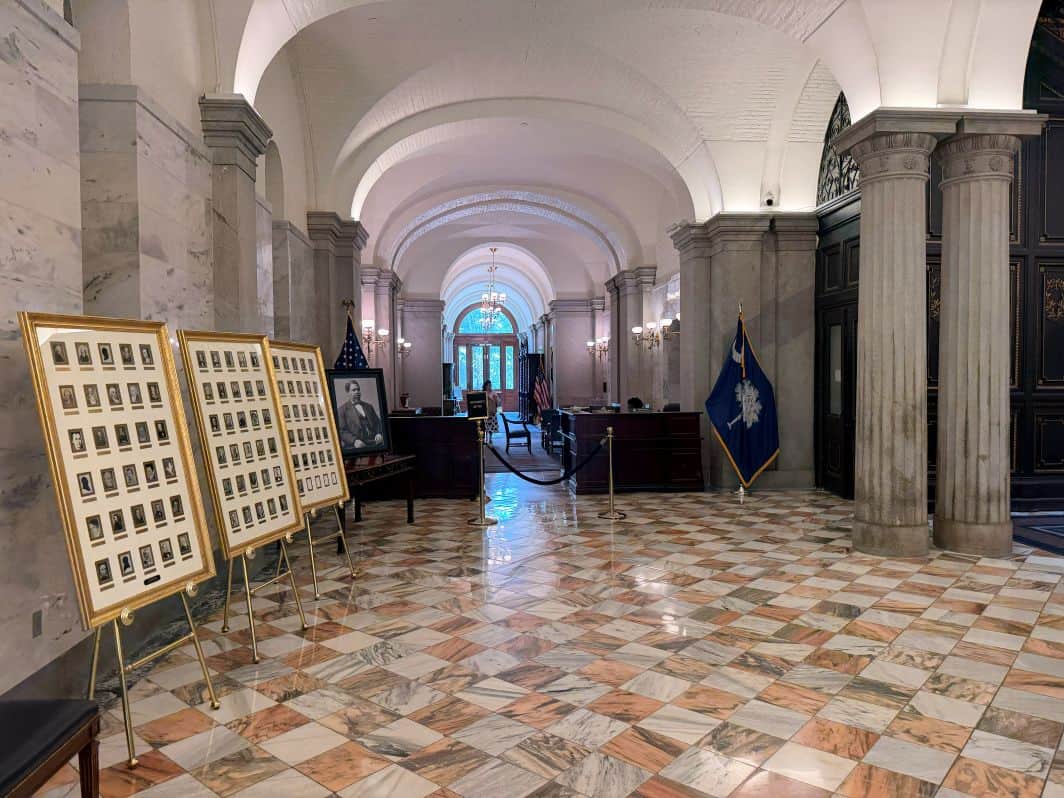
The first floor houses the offices of the Governor and the Lieutenant Governor, placing some of the state’s highest-ranking elected officials within these historic walls.
Making Your Way to the Second Floor
After exploring the first floor, visitors can make their way to the second level either by taking the elevator or by climbing the historic staircase.
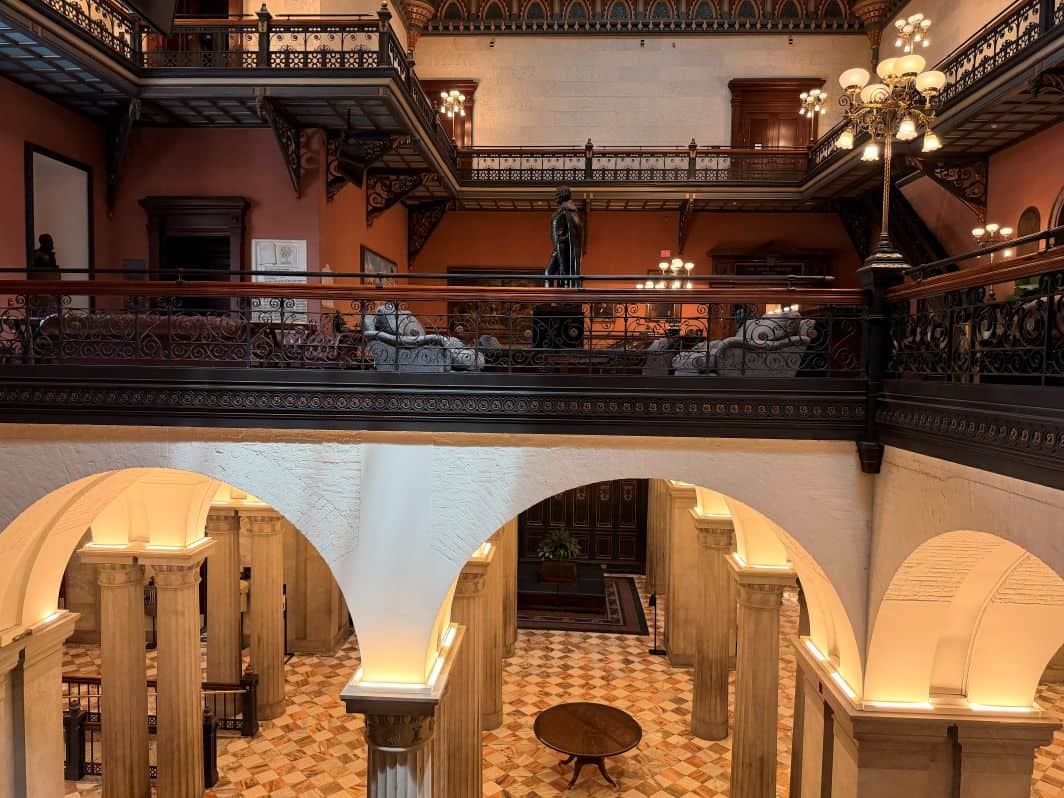
We chose the stairs and enjoyed the opportunity to admire the craftsmanship as we made our way upward.
The staircase provides a beautiful transition between floors.
As we reached the second floor, we expected to find the grand rotunda that serves as the centerpiece of so many state Capitols. Instead, we discovered one of the South Carolina State House’s most interesting architectural stories.
A Capitol Without a Traditional Rotunda
Construction of the Capitol began in 1855 but was interrupted by the Civil War.
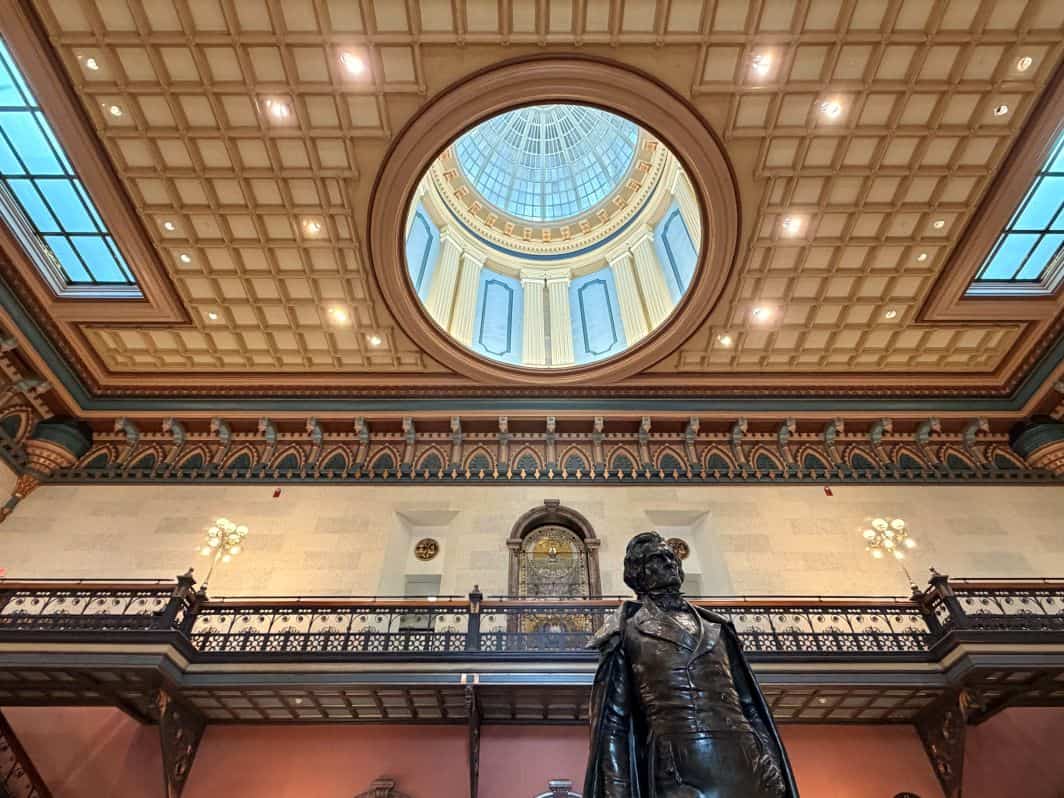
The exterior dome was completed during the rebuilding process, while the interior dome wasn’t finished until years later. Because the two domes were completed during different phases of construction, they don’t perfectly align.
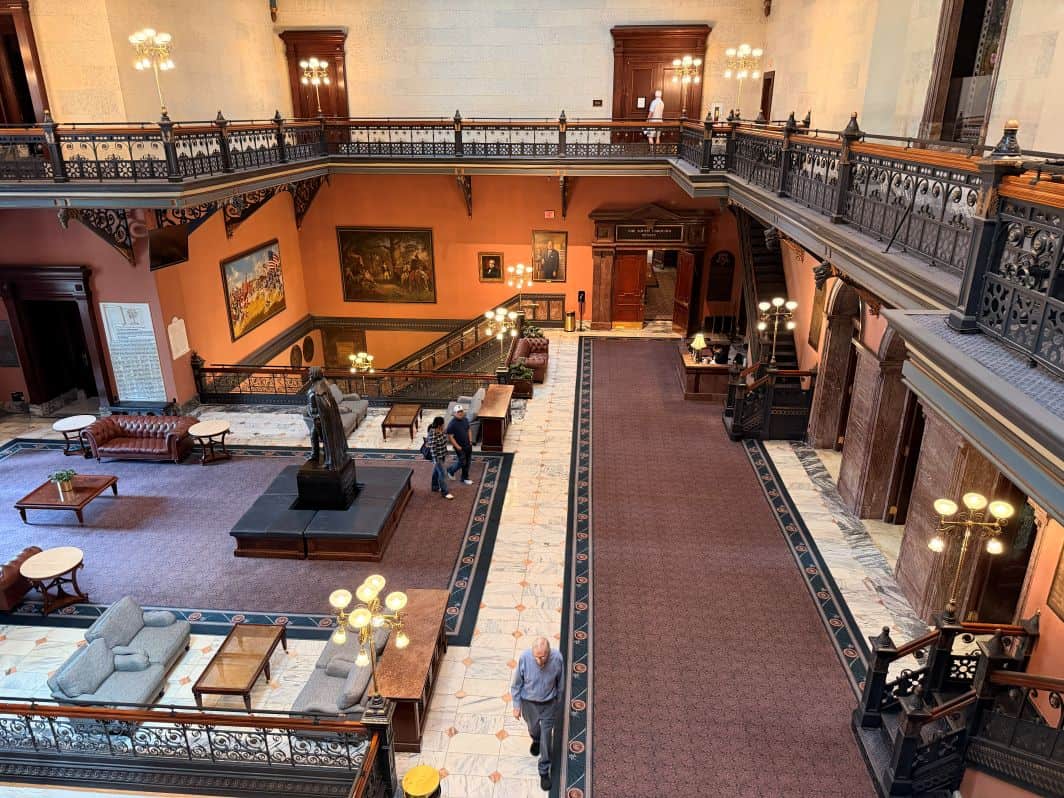
As a result, visitors won’t find the sweeping circular rotunda that many people expect beneath the Capitol’s dome.
Instead, the second floor is organized around the legislative chambers.
Looking Up at the Dome
Take your time looking up.
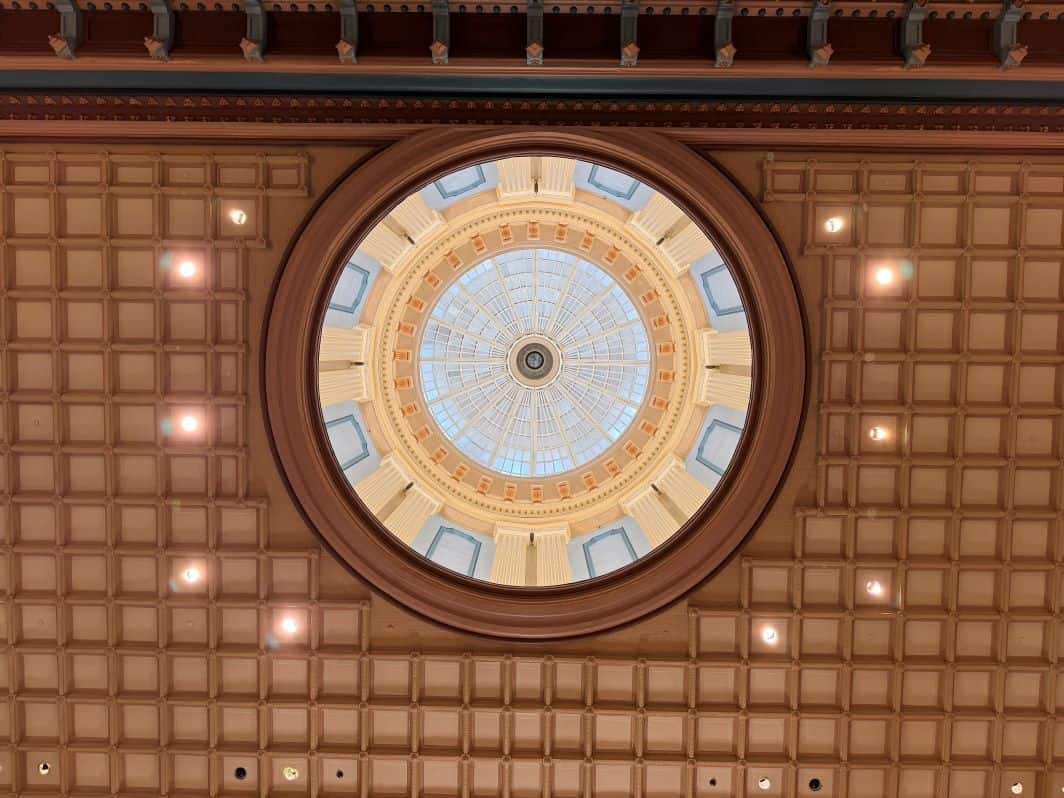
Knowing the history behind the Capitol makes it easier to appreciate what you’re seeing. The interior dome sits slightly offset from the exterior dome. A subtle detail that many visitors would never notice without learning the story behind it.
For us, this was one of those unexpected discoveries that made the tour memorable. It wasn’t the grandest architectural feature we’d seen, but it perfectly illustrates why we enjoy visiting every U.S. State Capitol. Every building has its own history, and sometimes the most fascinating stories are hidden in the details.
Second Floor: Where South Carolina’s General Assembly Meets
The second floor is home to the chambers where South Carolina’s General Assembly conducts its work.
The Senate
Located on the east side of the Capitol, the Senate Chamber is where South Carolina’s 46 senators meet.
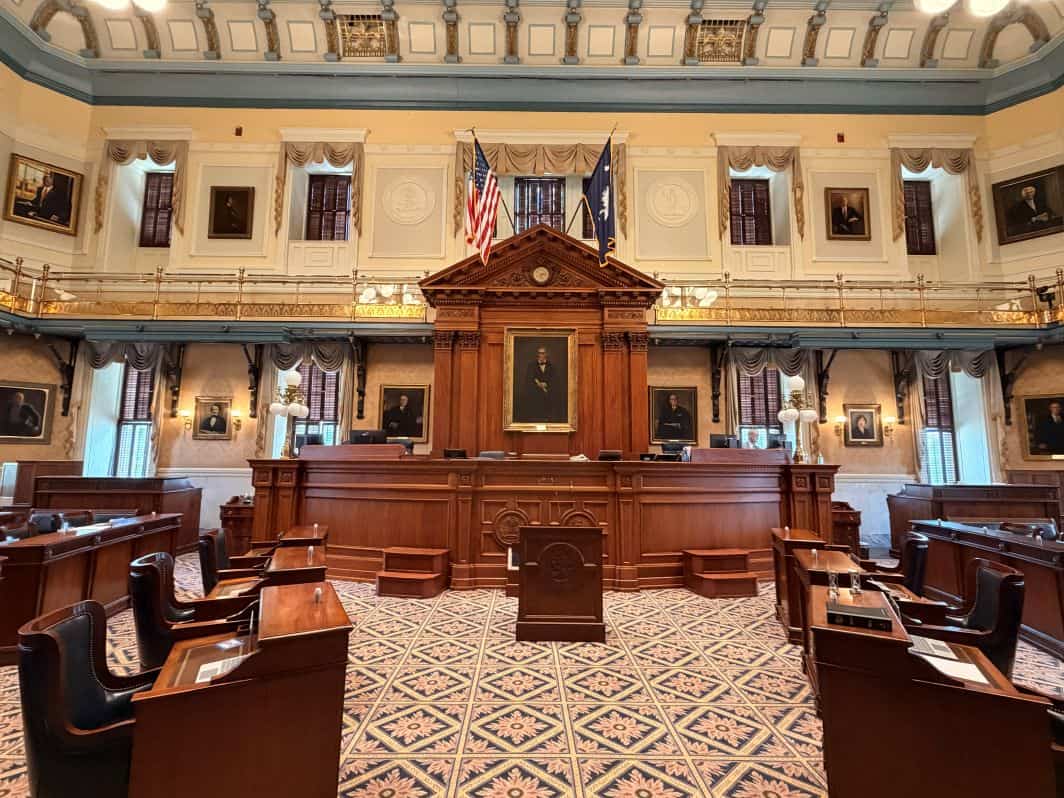
The seating arrangement follows seniority, with senators also separated by political party.
When the Senate is in session, the chamber proudly displays the ceremonial sword, representing the traditions and history of the legislative body.
The House of Representatives
On the west side of the Capitol is the House of Representatives Chamber. Unlike the Senate, representatives are arranged by county rather than by seniority.

When the House is in session, the State Mace is proudly displayed. This historic symbol represents the authority of the House and is the oldest continuously used state legislative mace in the United States.
Joint Legislative Conference Room (Library)
The Joint Legislative Conference Room, often referred to as the Capitol Library, contains several unique architectural details that make it one of the most interesting rooms in the South Carolina State House. Look up to admire the beautiful chandelier, which was originally powered by gas before being converted to electricity.
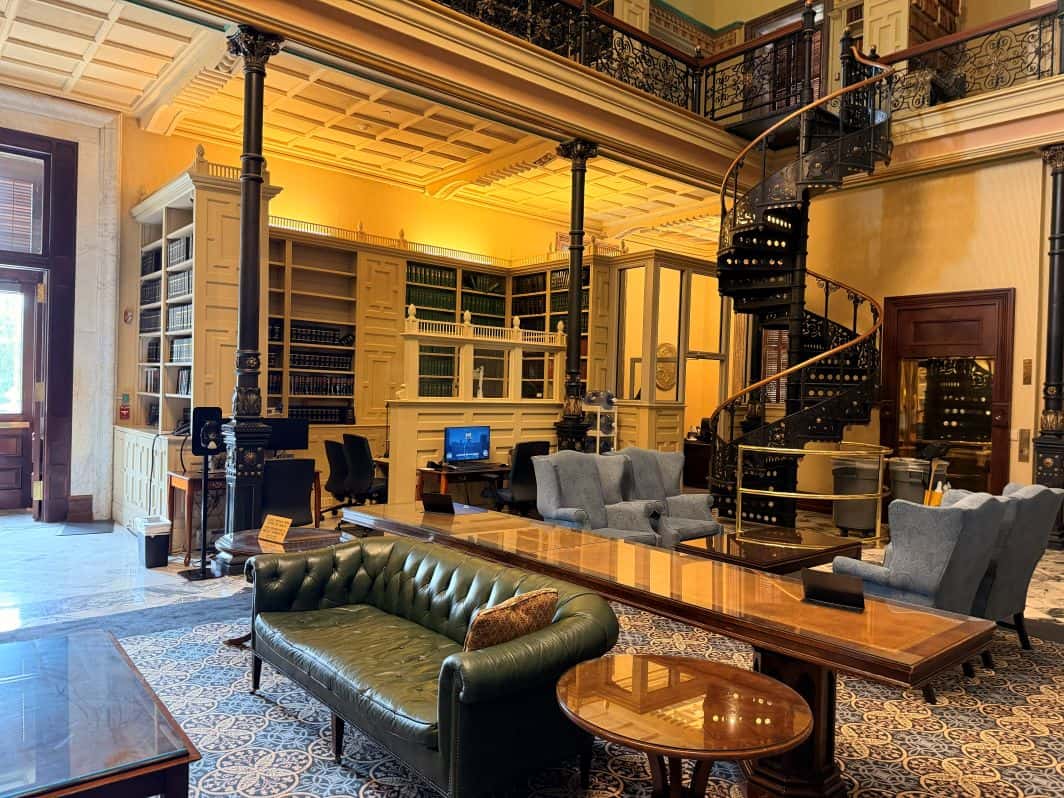
This is the only room in the building that has remained original, offering a rare glimpse of what the State House looked like when it was first built. The combination of details and the room’s continued use makes it a fascinating place to connect the building’s past with its role in South Carolina government today.
Beautiful Artwork, Sculptures, and Stained Glass
Throughout the Capitol, you’ll find impressive artwork, sculptures, and stained glass windows that tell the story of South Carolina’s history.
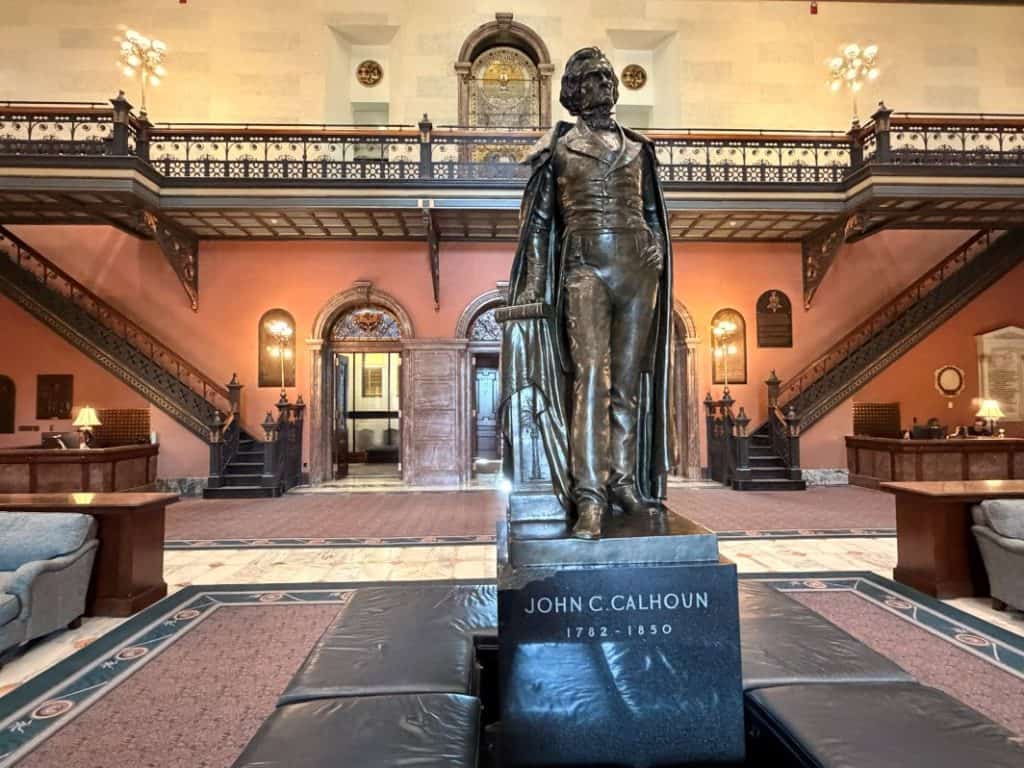
One of the most remarkable features is a stained glass window containing approximately 37,000 pieces of colored mosaic glass. The detailed craftsmanship is a reminder that every corner of the Capitol has a story waiting to be discovered.
Finding Stories by Exploring the Grounds
After you tour the inside of the Capitol, spend some time walking around the beautiful 22-acre Capitol Complex.
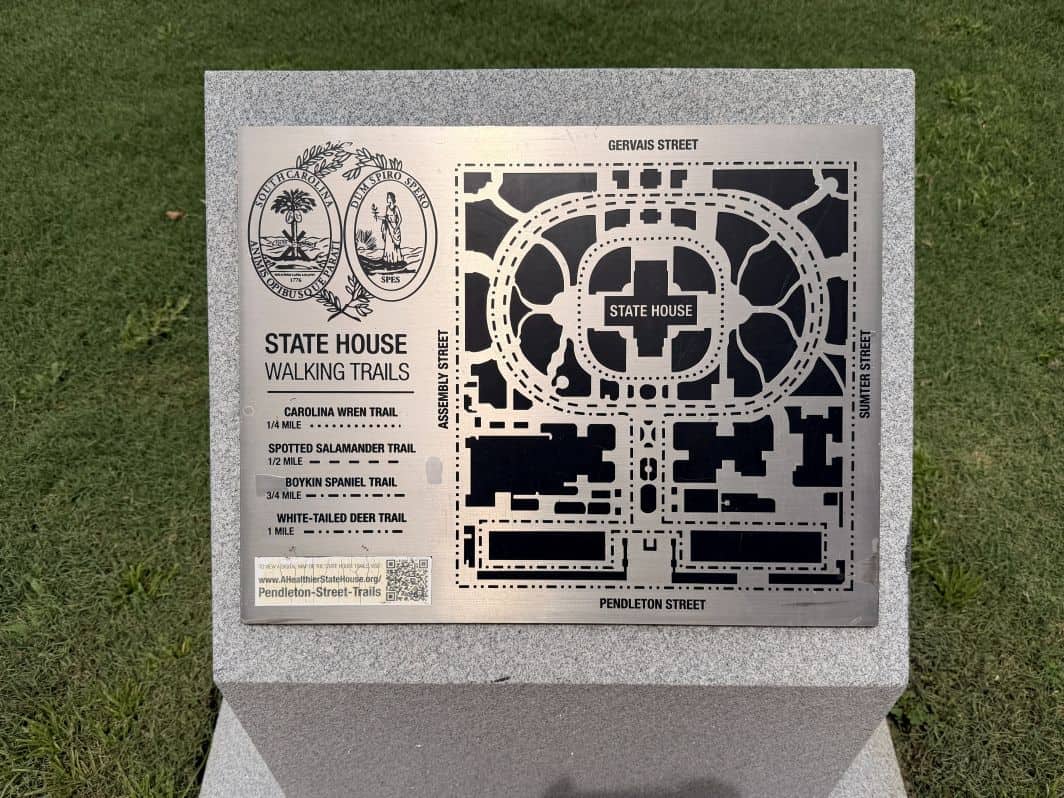
As travelers who enjoy walking, we appreciated that the grounds include four walking trails. The trails lead you to colorful gardens, historic monuments, statues, memorials, and plenty of places to stop and take in the scenery.
Six Bronze Stars
One detail you don’t want to miss is the six bronze stars embedded in the exterior walls of the State House.
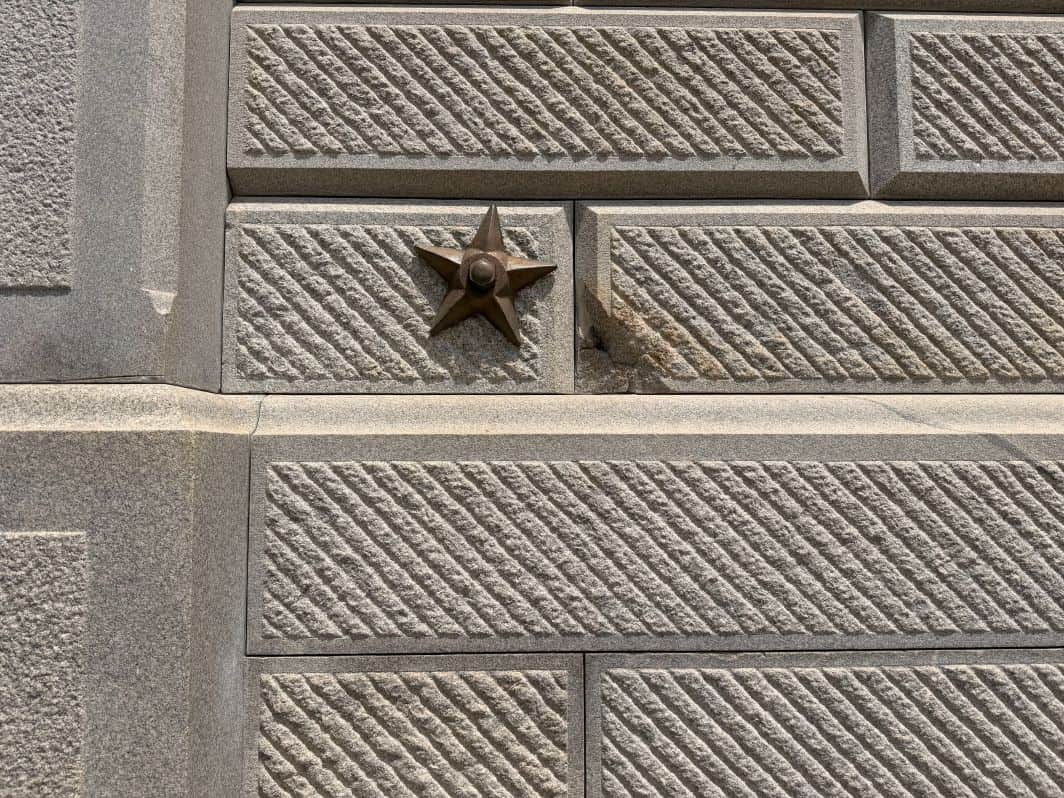
These stars mark where Union artillery shells struck the building during General Sherman’s attack on Columbia during the Civil War. Rather than repairing the damage completely, South Carolina chose to preserve these scars as a reminder of the state’s history.
Statue of George Washington
Another interesting stop is the statue of George Washington.

Look closely, and you’ll notice his walking cane is broken. The damage occurred during the Civil War and has intentionally been left unrepaired as another visible reminder of the conflict.
The Oldest Monument
While exploring the grounds, be sure to visit the Palmetto Regiment Monument, the oldest monument on the Capitol grounds.
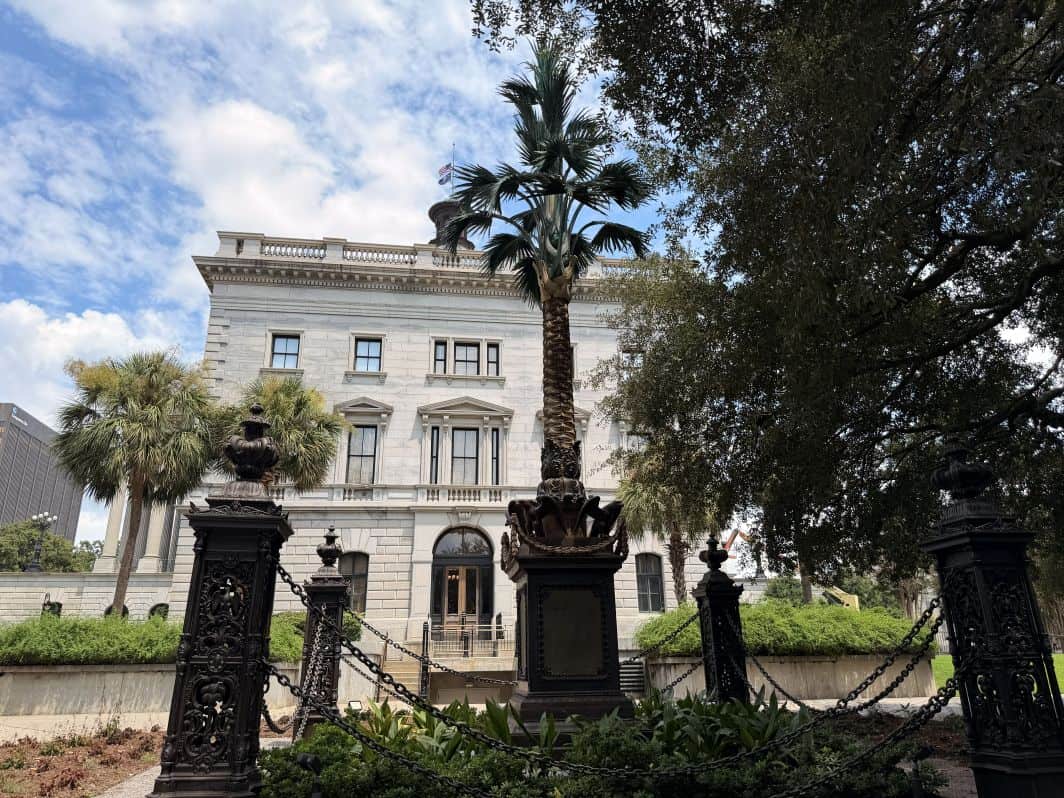
Its history makes it especially significant as it has stood through some of the most turbulent moments in South Carolina’s past, including the fighting that damaged the State House during the Civil War.
Seeing this historic monument still standing today is a reminder that the Capitol grounds are more than beautiful landscaping and statues. They are part of South Carolina’s story, with monuments that have witnessed generations of change.
The Blue Granite Columns
We were impressed by the massive blue granite columns, which are a remarkable example of the craftsmanship that went into the State House.
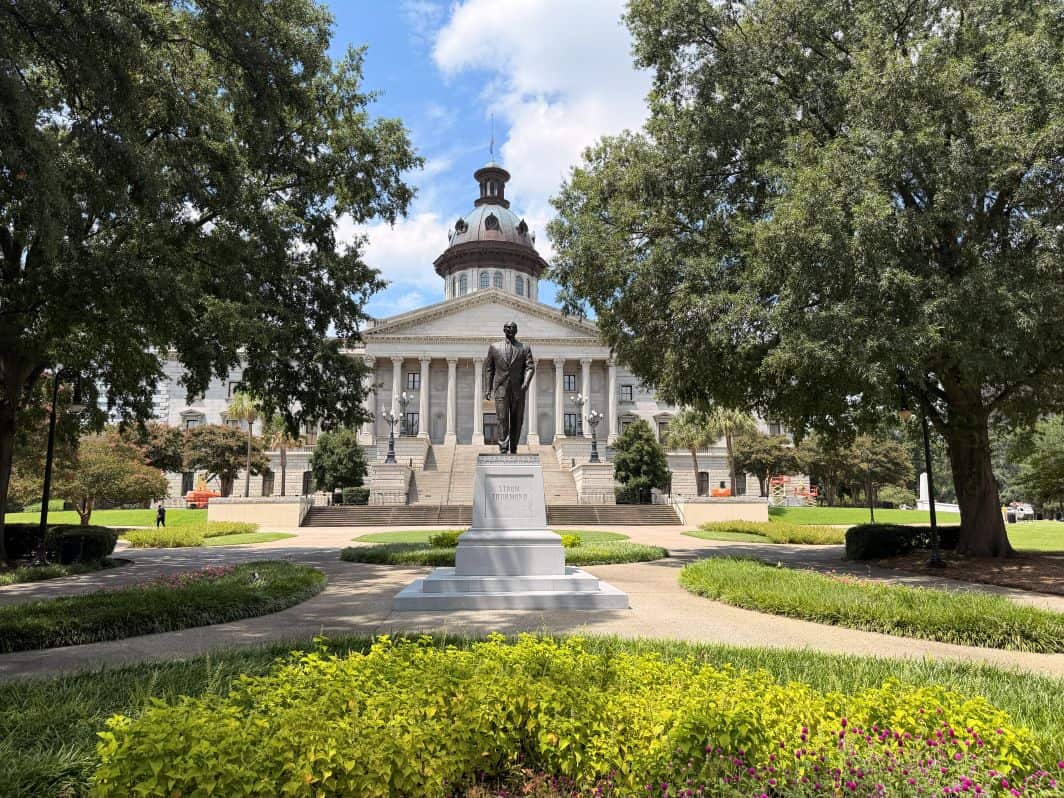
Even more impressive, the columns were carved from single pieces of stone.
Made from South Carolina blue granite, these enormous columns give the building a sense of strength and permanence.
The Dome Holds an Interesting Secret
Like many state capitols and the U.S. Capitol, South Carolina uses a dual-dome design.
What you see from outside is actually different from what you’ll experience once inside.

The exterior dome is covered with approximately 44,000 pounds of copper, which is roughly the weight of eight million pennies.
Sitting above the dome is a simple cupola and flagpole displaying both the United States flag and the South Carolina state flag.
It’s another reminder that every Capitol has its own unique engineering story.
Look at History from Different Angles
As you walk the grounds, take a moment to think about everything this place has witnessed. The building, monuments, and surrounding landscape have all been part of a changing South Carolina. What did these grounds look like more than 150 years ago? What did the people who stood here see, hear, and experience?

Looking at history from different perspectives can also change what you see. The monuments and memorials represent different people, experiences, and moments in time. One view may show you the beauty of the Capitol, while another may reveal a detail or story you hadn’t known before.
That’s something we’ve learned through our U.S. State Capitols Challenge. We’re not just checking another Capitol off our list. We want to look closer, ask questions, and understand the stories behind the places we visit. Sometimes, all it takes is changing your angle or your perspective to discover something new.
Continuing to Learn Something New
Every state capitol teaches us something new.
Some amaze us with incredible architecture. Others surprise us with hidden stories, historic scars, engineering details, or beautiful grounds that encourage us to slow down and explore.
The South Carolina State House reminded us that travel isn’t always about finding the biggest or most famous attraction. Sometimes it’s about taking the time to notice the little details: a bronze star in a wall, a broken walking cane, a stained-glass window made of thousands of pieces, or a monument that has stood for generations.
Those discoveries are what make the U.S. State Capitol Challenge so rewarding. We set out to see more of this beautiful country and learn more about each state, and we’ve also discovered there’s always another story to uncover, another detail to notice, and another perspective to consider.
Final Thoughts: South Carolina State House
The South Carolina State House may not be the largest Capitol we’ve visited, but it reminded us that every Capitol has its own story to tell. From its long and complicated construction history to the legislative chambers, historic artwork, monuments, and details hidden throughout the building and grounds, there was something new to discover.
If you’re planning a trip to Columbia, we highly recommend taking the free guided tour. The knowledgeable guides help bring the building’s history to life and point out fascinating details you might otherwise overlook. For us, that’s one of the best ways to experience a state capitol, not just by seeing the building, but by understanding the stories behind it.
Our visit to the South Carolina State House was another memorable stop on our 50 State Capitols Challenge. Each Capitol has given us a new opportunity to learn about the people, history, architecture, and traditions that have shaped its state.
And that’s what keeps us curious about the next one. There’s always something new to learn, another story to uncover, and another Capitol waiting to be explored.
Ready to Start Your Own U.S. Capitols Challenge?
Every state capitol has its own story to tell. Some will impress you with towering domes and grand rotundas, while others will surprise you with fascinating history, beautiful grounds, and unique architectural details you might otherwise overlook.
Our 50 U.S. State Capitol Challenge has become one of our favorite travel experiences because it has encouraged us to slow down, explore each state more intentionally, and discover the stories that make every capitol unique.
Whether you’ve already visited a few capitols or you’re just getting started, we hope you’ll join the challenge.
Read our complete guide to visiting all 50 U.S. State Capitols, follow our journey across the country, and start planning your own adventure. You may be surprised how much history, architecture, and local culture you’ll discover along the way.
Plan Your Next Adventure
Ready to start checking state capitols, or any destination, off your travel bucket list?
Visit our Travel Resources page to discover the same tools we use to plan our trips:
- ✈️ Flight booking tools
- 🏨 Hotel recommendations
- 📱 International phone plans
- 🎟️ Tours and experiences
- 🧳 Travel gear we actually use
Affiliate Disclosure
Mind Set On Travel may contain affiliate links to products and services, including Amazon affiliate links. If you make a purchase using one of our links, we may receive compensation at no additional cost to you. This helps support our work and allows us to continue sharing travel tips, resources, and mindset stories.
As an Amazon Associate, we earn from qualifying purchases.
Thank you for supporting Mind Set On Travel!
Read our full disclaimer here.